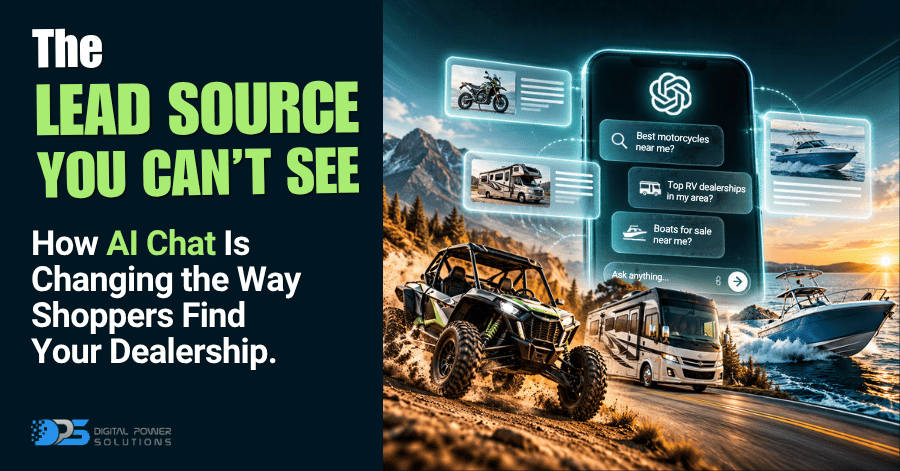
How AI Chat Is Changing the Way Shoppers Find Your Dealership
October 20, 2026


Is AI Sending Shoppers to Your Dealership or Your Competitor?
You work hard to get found. You keep your website fres, and make the lot look sharp. Then a shopper opens ChatGPT and types, "Where should I buy a travel trailer near me?" You have no idea what the answer says.
You may be the owner, the general manager, or the one person who handles marketing on top of five other jobs at your dealership. You have heard AI is changing how people shop, but don't know how to check whether it is helping you or quietly sending buyers down the road.
The good news is you can check this yourself in about 20 minutes for free. This guide shows you how to test whether AI tools mention your dealership, how to read what you find, and what to fix if you are missing.
Why AI Answers Now Matter for Your Dealer Leads
About 30% of in-market vehicle shoppers used an AI tool while researching, and 68.4% of those people used ChatGPT, according to a 2026 study from Ekho that looked at 627 shoppers in the fall of 2025. For comparison, only 15.8% said they used an OEM or dealer website. AI is already ahead of your website as a place to start.
Shoppers are not just asking about features, either. The Ekho team found they ask about fair used prices, brand reliability, whether a dealer handles warranty work well, and "Where can I buy this near me?" That last question is the one that decides who gets the phone call.
The visitors who come from those answers tend to be worth more. In a Cars.com survey of 936 people, 97% of AI users said AI would shape their purchase, and 41% said they would visit the site of a dealer an AI tool named. Research from Seer Interactive found that ChatGPT visitors converted at 15.9%, while Google organic visitors converted at 1.76%, as reported by Demand Local. Fullpath also saw visits to dealer sites that came from AI chat tools grow 43% in a single month in September 2025 (same source).
This matters even more if you sell RVs, boats, or powersports. The Rollick 2026 Future of Buying Study asked 17,764 recent shoppers across 31 brands. It found that 61% want an AI agent to answer product questions, and 65% want AI to help with insurance, financing, and cost of ownership. Almost half of RV shoppers (45%) take four months or more to buy, so they have plenty of time to ask AI a lot of questions.
Here is the tricky part. Blue Jar, citing SOCi data, reports that ChatGPT recommended only 1.2% of business locations, while 35.9% showed up in Google's local 3-pack. Being easy to find on Google does not mean AI will name you. The only way to know is to ask.
One fair warning: several of these numbers come from companies that sell AI tools or marketing services, so treat them as a strong hint about where things are going, not as a promise about your store.
How to Test Whether AI Recommends Your Dealership, Step by Step
No special software needed. You need a laptop, a notebook or spreadsheet, and about 20 minutes. Here is the plan.
- Pick your three tools. Start with ChatGPT, Google's Gemini, and Perplexity. The Ekho study found ChatGPT was used by 68.4% of shoppers who tried AI, with Gemini in second place and Perplexity after that. Also type one of your questions into Google and look at the AI summary at the top of the results.
- Use a clean window. Open a private or incognito browser window, or log out. Past chats can change what the tool says, and you want to see what a brand-new shopper would see.
- Put your town in every question. AI tools answer "best RV dealer" with a list from anywhere. Add your city, or a nearby city your customers drive from.
- Ask like a shopper, not like a dealer. Skip your slogan and your brand words. Use plain questions the way a buyer would type them on their phone.
- Ask the same questions in all three tools. Copy each answer into your notes. Do not trust your memory. These tools can give different answers to the same question on different days.
- Mark what you see. For each answer, write down whether you were named, whether the facts about you were right (hours, phone, brands you carry), and which competitors showed up instead.
- Save it with a date. You will run this again next month, and the old notes are how you know whether you are moving up.
This test shows you a snapshot, not a perfect score. Answers change from person to person and day to day. That is fine. You are looking for patterns. If you never show up in 30 answers, that tells you something. If you show up with the wrong phone number, that tells you something too.
Sample Questions to Ask for Car, RV, Motorcycle, and Boat Dealers
The Ekho researchers sorted real shopper questions into four groups: learning the basics, comparing models, checking price and reputation, and finding where to buy. Test at least one question from each group. Swap in your own city, brands, and models.
RV dealers
- "What size travel trailer can my half-ton truck tow?"
- "Which RV dealers near [your city] have a good service department?"
- "What would the monthly payment be on a $40,000 travel trailer?"
- "Where can I trade in my camper near [your city]?"
Motorcycle and powersports dealers
- "How should I choose my first dirt bike?"
- "Where can I buy a [model] near [your city]?"
- "Which powersports dealer near [your city] is good at service and warranty work?"
- "What is my used side-by-side worth?"
Boat dealers
- "What is the difference between a pontoon and a deck boat?"
- "Which boat dealers near [your city] are best for a family pontoon?"
- "What is the monthly payment on a $45,000 pontoon boat?"
- "What should I check before buying a used boat?"
For every dealer
- "Is [your dealership name] a good place to buy? What do reviews say?"
- "What are the hours and phone number for [your dealership name]?"
That last pair is the quickest check of all. If AI gets your own name, hours, or phone number wrong, you have found a problem you can fix this week.
How to Read Your Results and Track Them Every Month
Once you have your answers, sort each one into one of four buckets.
- Named, and the facts are right. Great. Note which question got you there so you can write more content like it.
- Named, but the facts are wrong. Fix this first. A shopper who gets the wrong phone number or old hours may never reach you. This is also the easiest win.
- Not named, and a competitor is. Open that competitor's website and Google listing. Look at their reviews, their price info, and their content. You are looking for what they do that you do not.
- Not named, and nobody local is. Good news in a way. The field is open, and a few fixes can put you in front.
Then keep a simple sheet. Copy this table into a spreadsheet and add a row for every question, every tool, every month.
|
Date |
Tool |
Question asked |
Did it name us? |
Facts right? |
Competitor named |
|---|---|---|---|---|---|
|
Nov 2 |
ChatGPT |
Where can I trade in my camper near [city]? |
|
|
|
|
Nov 2 |
Gemini |
Where can I trade in my camper near [city]? |
|
|
|
|
Nov 2 |
Perplexity |
Where can I trade in my camper near [city]? |
|
|
|
At the end of each month, count how many answers named you out of the total you asked. If you asked 30 and showed up in 4, your score is about 13%. Next month, try to beat it.
Set a calendar reminder for the first Monday of each month. This takes the same 20 minutes, and it keeps you from guessing.
What to Fix When AI Does Not Mention Your Dealership
If you did not show up, no worries. Most of the fixes are things you already know you should do. AI tools pull from what is on the web, so the goal is to make your store easy to find, easy to trust, and easy to quote.
- Make your basics match everywhere. Your name, address, phone number, hours, and prices should be the same on your website, Google Business Profile, Facebook, and every listing site. When sources disagree, AI tools have a harder time knowing which one to believe, and shoppers lose trust fast.
- Work on your reviews. Blue Jar, citing SOCi data, reports that the locations ChatGPT recommended averaged 4.3 stars, compared with 3.9 for Gemini and 4.1 for Perplexity. That is a small sample from one study, but the message is clear: ask happy customers for a Google review, and answer the unhappy ones.
- Tidy up your Google Business Profile. Add your real photos, correct categories, current hours, and the brands you carry. It is free, and AI tools often lean on local info like this.
- Write pages that answer real questions. In a study of 151 dealership websites, Blue Jar reports (citing C-4 Analytics) that 85% had at least one page cited in Google's AI Overviews, and about 77% of the searches that triggered those citations were informational, not inventory searches. Pages like "What size RV can my truck tow?" or "Pontoon vs. deck boat" give AI something to quote.
- Ask your website provider about structured data. Structured data, sometimes called schema, is a bit of code that tells search tools exactly what a page is: a vehicle, a store, a review. Blue Jar recommends adding it to every vehicle page.
- Show prices clearly. One price, the same everywhere, with no "call for price." Shoppers compare what AI told them with what your site says.
Give changes time. There is no magic switch, and no one can promise you a date when ChatGPT will start naming you. Make the fixes, run your monthly test, and watch the trend.
Turn AI Visitors Into Leads With Trade-In and Payment Tools
Getting named is only half the job. When a shopper clicks from an AI answer to your website, they need a reason to engage instead of hitting the back button.
The Ekho team notes that AI users arrive on dealer sites already informed and closer to buying. They do not want a "Contact Us" form and a three-day wait. They want numbers.
The Rollick study backs that up. More than half of shoppers in every segment prefer to explore financing online, and 54% of RV shoppers and 62% of powersports and marine shoppers want online credit approval. Shoppers also want to handle trade evaluations and quote requests before they ever visit a dealership.
This is where our tools fit. TradeCycle lets a shopper find out what their trade is worth in a few minutes. PayCycle lets them shop by monthly payment instead of sticker price, which is how most people think about a big purchase. Both turn a curious visitor into a lead with a name, a phone number, and the exact unit and trade they care about.
That detail changes your follow-up call. Instead of "Hi, did you have any questions?" your salesperson can say, "I saw you were looking at the 2022 travel trailer around $489 a month, and your trade came in near $14,000. Want to come see it?" That is a very different call.
A few simple tips make these tools work harder for AI visitors:
- Put the trade-in and payment tools where people see them, on vehicle pages and your homepage.
- Send every lead straight into your CRM so your team can reply fast.
- Answer within minutes. These shoppers are already talking to a tool that replies instantly.
If an AI answer is the front door to your store, your website tools are the first conversation inside.
Start Your First AI Visibility Test Today
You cannot control what ChatGPT, Gemini, or Perplexity say about your store. You can find out what they say, fix what is wrong, and make your dealership easier to recommend. That starts with a simple test and a spreadsheet.
Here is your short list for this week:
- Ask 10 shopper questions in three AI tools and record the answers.
- Check that your name, hours, phone number, and prices match everywhere.
- Ask your happy customers for reviews.
- Add one helpful question-and-answer page to your website.
- Put a trade-in tool and a payment tool in front of every visitor, so a click from an AI answer turns into a real lead.
If you want more step-by-step help like this, our Modern Dealership Growth Playbook walks powersports, RV, and marine dealers through eight modules, with an Action Checklist for each one. And if you would like to see how TradeCycle and PayCycle can turn more of your website visitors into leads, reach out to the Digital Power Solutions team for a quick demo.
Someone’s ready. Are you?
Ready to see it in action?
Sources
- Ekho, 2026 AI Vehicle Research Study: How Buyers Are Using ChatGPT and Other AI Tools to Find Their Next Vehicle (January 2026)
- Blue Jar, 1 in 4 Car Buyers Now Ask AI Which Dealer to Visit (cites Cars.com, SOCi, and C-4 Analytics)
- Demand Local, 37 ChatGPT Referral Traffic Statistics for Auto Dealers (cites Seer Interactive and Fullpath)
- RVBusiness, Rollick Releases 2026 "The Future of Buying 2.0" Study
Note: Ekho, Blue Jar, and Demand Local sell AI or marketing services, and some statistics here are reported second-hand through their articles. Treat them as a guide to the trend.