Boat Show, RV Show, and Bike Rally Season: How Dealers Can Turn Show Traffic Into Leads
October 14, 2026

You Know Your Marketing Is Working But You Can’t Prove Where It’s Coming From.
Some leads come from Google, some come from Facebook, and some come from third party listing sites. And then there’s that big, frustrating bucket labeled “direct” that tells you basically nothing.
Shoppers are finding you somehow, you just don’t know how. And when you can’t see where leads come from, it’s hard to know where to spend your next marketing dollar.
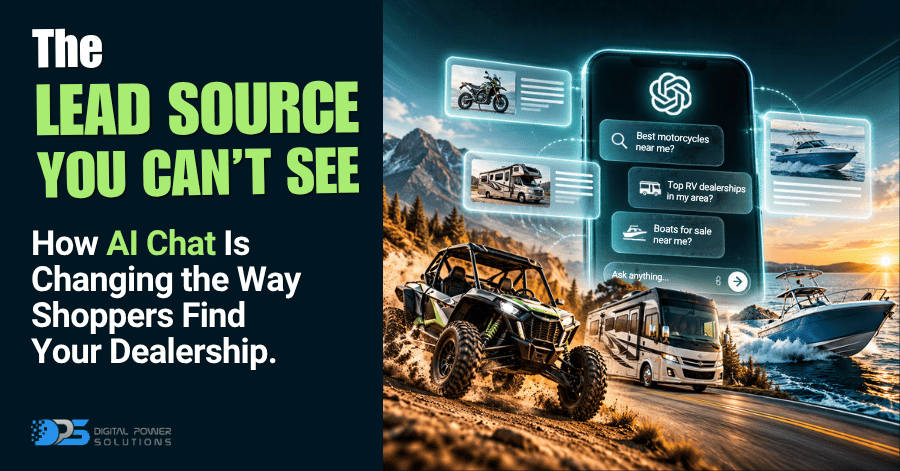
A growing chunk of those mystery visitors started their shopping journey by asking an AI tool like ChatGPT or Gemini a question. “What’s the best travel trailer for a family of five?” “Which side by side is good for hunting?” “Where can I buy a pontoon boat near me?”
The AI gave them an answer. Some of them clicked through to your site and your analytics probably filed them under “direct” or “referral” without a second thought.
You already have enough to keep track of. But this new touchpoint is too important to ignore. Let’s walk through what’s happening, the good and the bad, and the right way to handle it.
AI Chat Is Now Part of the Shopping Journey
A couple of years ago, almost nobody used AI to shop for a vehicle. Now it’s everywhere.
Cox Automotive’s 2026 Car Buyer Journey Study found that 19% of all vehicle buyers and 25% of new car buyers now use AI tools like ChatGPT or Google AI Overviews during their research (Phyron). A Cars.com survey found that 44% of shoppers have used AI tools when shopping for a vehicle, and 97% said the technology will influence their future purchases (CBT News).
ChatGPT leads the pack. Among shoppers who used AI, 68.4% used ChatGPT, more than all other AI tools combined (Ekho). And these shoppers are landing on dealer websites.
After a slow start to the year, dealerships saw a 34.5% jump in traffic from AI chat sources in March 2026. ChatGPT still sent most of that traffic, but Google Gemini grew from a 1.5% share at the end of 2025 to 8.5% by April 2026 (Dealership Guy).
Why AI Shoppers Are Worth Your Attention
Not all website visitors are equal. AI shoppers tend to show up ready to act.
Think about how someone uses ChatGPT. They don’t just type two words, they ask follow up questions, ccompare models, talk about their budget and what they need. By the time they click through to a dealer’s site, they’ve already done a lot of their homework.
The numbers back this up. In retail, Adobe reported AI traffic converting 42% better than other traffic by March 2026, and 54% better by May (LovedBy). After using AI tools, shoppers are most likely to visit a cited dealer or manufacturer website next (Digital Dealer).
There’s also something interesting happening with AI chat tools on dealer websites. Fullpath identified what it calls a “six message threshold.” Shoppers who send a sixth message to an AI chatbot see their conversion likelihood jump six times, to a 45.6% conversion rate (Dealership Guy). In plain terms, the more a shopper talks with AI, the more serious they tend to be.
The Problem: Most Dealers Can’t See This Traffic
Until recently, Google Analytics didn’t separate AI tools from regular referral traffic, so AI visitors stayed hidden unless you set up a custom channel (Terminus). Google added a built in “AI Assistant” channel in May 2026, but it leaves out Perplexity and any visit that arrives without referral information (DarwinApps).
A March 2026 study found that 83% of AI use worldwide happens in mobile apps, and concluded that web only tracking undercounts AI use by four to five times (LovedBy). When someone taps a link inside the ChatGPT app, your analytics often can’t tell where they came from. So that visit lands in your “direct” bucket.
Then there’s your CRM. Even if your analytics catches AI traffic, that info usually doesn’t follow the lead into your CRM. Your sales team sees a name and phone number, but no clue that the shopper spent 20 minutes chatting with AI about that exact model before filling out your form.
When you can’t see a lead source, you can’t measure it, improve it, or give it credit. You might cut a marketing channel that was actually feeding those AI answers.
The Positives and the Negatives
Let’s be honest about both sides.
The positives:
- High intent shoppers. AI users have usually narrowed their choices and are closer to buying.
- Fast growth. Traffic from AI platforms to dealer websites grew more than 15 times year over year (Dealer AI Guy).
- A chance to stand out early. Many dealers haven’t caught on yet, so getting ahead now gives you an edge.
The negatives:
- It’s still small. Across nearly 75,000 websites, AI chatbots sent just 0.28% of total web traffic in March 2026 (Ahrefs). Don’t drop what’s working to chase it.
- You don’t control the answer. A study found that when ChatGPT was asked to act like a local shopper, the target dealership showed up first only 77% of the time. In 9% of cases, it didn’t show up at all, even with the vehicle in stock (Dealer AI Guy).
- Trust is shaky. 63% of shoppers worry AI tools might recommend vehicles in a biased way (Digital Dealer). They’ll still want to check facts on your site.
- It’s hard to measure perfectly. Even with the best setup, some AI traffic will slip through as “direct.”
The Right Way to Track AI Traffic
Here’s a simple plan you or your website provider can follow.
- Check what you already have. In Google Analytics 4, open your Traffic Acquisition report and look at the Referral channel. If you see sources like chatgpt.com, perplexity.ai, or gemini.google.com, you’re already getting AI visitors.
- Turn on the AI Assistant channel. Make sure Google’s built in AI Assistant channel is showing in your reports.
- Build a custom AI channel. Because the built in channel misses some sources, create your own. In GA4, go to Admin, then Data display, then Channel groups, and create a new group. Add a channel called “AI Traffic” and set it to match sources using a pattern like chatgpt|openai|perplexity|claude|gemini|copilot (Abmatic). Then move it above Referral so it gets checked first.
- Pass the source into your CRM. Add a hidden field to your website forms that captures where the visitor came from, then map that into your CRM lead records so it follows the lead all the way to a sale (DarwinApps).
- Just ask. Add “AI tool like ChatGPT” as an option on your “How did you hear about us?” question, both online and in the showroom. It’s low tech, but it catches the visits analytics misses.
- Review it monthly. Look at how many AI visitors you get, which pages they land on, and how many turn into leads.
*How to Show Up in AI Answers
Tracking is only half the job. You also want AI tools to mention you in the first place.
- Keep your website accurate. AI tools pull from what’s online. Make sure your inventory, prices, hours, and contact info are correct and match everywhere.
- Use one consistent price. Shoppers will compare what AI tells them with what they see on your site. A price that changes from one platform to the next hurts trust fast.
- Polish your Google Business Profile and reviews. AI tools often lean on reviews and local info to recommend dealers.
- Answer real questions on your site. Add helpful pages that answer what shoppers actually ask: “What size RV can my truck tow?” or “What’s the difference between a pontoon and a deck boat?” Clear answers are easier for AI to pick up.
- Test it yourself. Once a month, ask ChatGPT, Gemini, and Perplexity a few questions your shoppers would ask, and see if your dealership shows up (Phyron).
- Side note: paying for ChatGPT ads won’t make your dealership show up more in ChatGPT’s actual answers. It buys a separate, labeled ad spot.
Give AI Shoppers a Reason to Choose You
AI shoppers arrive with a plan. They’ve already compared models. Now they want two answers fast: “What will this cost me each month?” and “What’s my trade worth?”
If your site makes them hunt for those answers, they’ll leave. If your site answers them right away, they become a lead.
That’s where Digital Power Solutions comes in. PayCycle lets shoppers browse your inventory by monthly payment, so they can see what fits their budget in seconds. TradeCycle gives them a trade value right on your site. Both turn high intent visitors into real leads with names, phone numbers, emails, and buying details your sales team can use.
And when your forms capture the visitor’s source, you’ll finally see which of those leads started with an AI conversation.
Your AI Traffic Checklist
- Look for AI sources in your GA4 Referral report.
- Turn on the AI Assistant channel.
- Build a custom AI Traffic channel and move it above Referral.
- Capture lead source in a hidden form field and send it to your CRM.
- Add “AI tool” to your “How did you hear about us?” question.
- Keep inventory, pricing, and hours accurate everywhere.
- Build pages that answer common shopper questions.
- Test your visibility in AI tools once a month.
- Make payments and trade values easy to find on every unit.
Don’t Let Your Best Shoppers Stay Invisible
AI chat isn’t replacing Google or your other marketing. But it’s becoming a big part of how shoppers find you, and those shoppers are often the most serious ones. The dealers who start tracking and preparing now will understand their customers better and make smarter marketing choices down the road.
Someone’s ready. Are you?
Ready to see it in action?
Sources:
AI powered digital marketing is driving higher dealer conversions at lower cost: Dealership Guy
How to engage and convert car buyers with automotive video: Phyron
Consumers Embrace AI but Still Rely on Dealerships: CBT News
2026 AI Vehicle Research Study: Ekho
The State of AI Traffic for Small Businesses 2026: LovedBy
AI’s Influence on Car Shopping Skyrockets: Digital Dealer
The AI Traffic Channel in GA4: Terminus
How to Track ChatGPT, Gemini and Perplexity Referral Traffic in GA4 and CRM: DarwinApps
Daily Brief, June 15, 2026: Dealer AI Guy
Daily Brief, March 16, 2026: Dealer AI Guy
AI Chatbot Traffic: What It Is, and How to Get More: Ahrefs
Track AI Referral Traffic in GA4: Abmatic